As you may have noticed the site hasn't been active during the last month in this time we have been hard at work on the new site which we are now pleased to present

www.uklockdown.com


Thanks to all the supporters we've gained here at blogger.com it is now time to move to a new battlefield to continue the fight.

"England is no longer controlled by Britons, we are under the invisible Jewish dictatorship, a dictatorship that can be felt in every sphere of life" - Nesta Helen Webster (1876 - 1960)

The Jewish Question Media Control Banking Control Crime Families
Jewish Lobby Terrorism Holocaust™ History
The EU Question Big Brother Tyrannical Laws Immigration EU History
General Films Enviro-marxism Brave Citizens Jew Lists Famous Quotes Other


Key News Stories

Man Arrested for sending out 7/7 DVD's

Gordon Brown Admits UK is in an Economic Depression

Face Scanners in Schools

All Emails to be recorded says EC Directive

Big Brother State goes after 4 Year olds

Western Apocalyspe, New World Order

MI5 say we are all potential terrorists

Poisoned Tap Water

Vermin Infested NHS Hospitals

Boycott Israel

Recent News

Rise in Attacks on British Jews

Jew owned Google up to their usual tricks

UK says no to Euro

Jews turn British Goyim into gambling addicts

Another Day, Another Retail Chain Collapses, Zavvi Eats Dirt

BBC fined for fraud again

Woolworths' Last Christmas, 30,000 Unemployed

Goldman Sachs swindle us again

Zionist Watch

Jews campaign for more asylum seekers

Why Do People Hate Israel ?

Ben Bradshaw MP 'Israel has history of bullying BBC'

Just Another Jewish Banking Scam

Trainee Rabbi accused of sexually assaulting 12-year-old boy

Rampant Rabbi Breeds again

Jew Scum Winehouse degrading the Caribbean

Psycho Jews Murder more innocent children

Crypto-Jew childrens TV actor jailed over child porn

Crypto-Jew Jack Straw to Jail Preachers for reading Bible

Britain's Top EU Cheerleader, Crypto-Jew Peter Mandelson

Britain's Top commercial campaigners for ID cards, Jewish Saatchi and Saatchi agency

British Jew Pervert has 7 wives and 8 children

Dictionary Corner

ZOG

Crypto-Jew

Goyim

Health Info

Fluoride is detrimental to both physical and mental health and is known to be the root cause of many medical conditions and ailments, Non Fluoride toothpaste is available at most health stores and online and some brands can even be found in various supermarkets.

NHS Hospital Patient is starved to death

Gender Bending Chemicals in Plastic Bottles

Mobile Phones Causing Cancer

Overcrowded Hospitals Spreading Diseases

UV Radiation From Energy Saving Bulbs

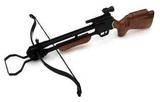
Defend Your Home
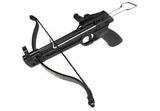
Learn Archery

Buying and selling Crossbows and Airguns is not illegal in the UK, after the global economy collapses in 2009/2010 the crime rate will explode, your home will not be safe unless you are prepared to defend it, you have been warned.

Miscellaneous

Official Documents

Click the Image below to get Adobe Reader

POLICE CORRUPTION IN ENGLAND AND WALES: An assessment of current evidence 2003

UK DEPARTMENT OF DEFENCE DOCUMENT Titled - DCDC Global Strategic Trends Programme 2007-2036

POLICE RESEARCH PAPER SERIES 110
Titled - Understanding and preventing police corruption: lessons from the literature 1999

Showing posts with label Media control. Show all posts

Robert Maxwell


Ian Robert Maxwell MC (10 June 1923 – 5 November 1991) was a Czechoslovakian-born British media proprietor and former Member of Parliament (MP), who rose from poverty to build an extensive publishing empire, which collapsed after his death due to the fraudulent transactions Maxwell had committed to support his business empire, including illegal use of pension funds.

Business activities

Maxwell long sought to buy a daily newspaper, hoping to exercise political influence through the media. In 1969 he was prevented from buying the News of the World by Rupert Murdoch, who became his arch rival in the British newspaper world. The battle for the News of the World was particularly acrimonious, Maxwell accused Murdoch of employing "the laws of the jungle" to acquire the paper and said he had "made a fair and bona fide offer... which has been frustrated and defeated after three months of [cynical] manoeuvring". Murdoch denied this, arguing the shareholders of the News of the World Group had "judged [his] record in Australia".

In 1970 Maxwell established the Maxwell Foundation in Liechtenstein, a tax haven. A condition of this type of company was that very little information is publicly available, which according to the Department of Trade and Industry suited Maxwell's business methods[citation needed]. In 1974 he reacquired PPL. In 1981 Maxwell acquired (through PPL) the British Printing Corporation (BPC) and changed its name to the British Printing and Communication Corporation (BPCC). The company was later sold off to a management buy-out, and is now known as Polestar. In July 1984 Maxwell (again through PPL) acquired Mirror Group Newspapers from Reed International plc. MGN were publishers of the Daily Mirror, a pro-Labour Party newspaper. He also bought the American interests of the Macmillan publishing house.

By the 1980s Maxwell's various companies owned the Daily Mirror, the Sunday Mirror, the Scottish Daily Record and Sunday Mail and several other newspapers, Pergamon Press, Nimbus Records, Collier books, Maxwell Directories, Prentice Hall Information Services, Macmillan (US) publishing, and the Berlitz language schools. He also owned a half-share of MTV in Europe and other European television interests, Maxwell Cable TV and Maxwell Entertainment. In 1987 Maxwell purchased part of IPC Media to create Fleetway Publications.

Maxwell pioneered the dissemination of highly specialized scientific information, responding to the exponential growth of investment in academic research. After 1970, when research universities diverted attention from the growth of their libraries to the growth of financial reserves, he and other publishers were blamed for greatly increased subscription fees for scientific journals. The need to maintain profits for publishers and the profitability of higher education institutions created budget difficulties for academic libraries, and for publishers of monographs. At the same time, Maxwell's links with the Eastern European totalitarian regimes resulted in a number of biographies (normally considered to be hagiographies) of those countries' then leaders, with sycophantic interviews conducted by Maxwell, for which, in the UK, he received much derision.

Maxwell was also well known as the chairman of Oxford United Football Club, saving them from bankruptcy and leading them into the top flight of English football, winning the League Cup in 1986. Oxford United were to pay a heavy price for his involvement in club affairs when Maxwell's questionable business dealings came into the public domain. Maxwell bought into Derby County F.C. in 1987. He also attempted to buy Manchester United in 1984, but refused to pay the price that the owner Martin Edwards had put on the club.

Death

On 5 November 1991, at the age of 68, Maxwell is presumed to have fallen overboard from his luxury yacht, the 'Lady Ghislaine', which was cruising off the Canary Islands, and his body was subsequently found floating in the Atlantic Ocean. He was buried on the Mount of Olives in Jerusalem. The official verdict was accidental drowning, though some commentators have surmised that he may have committed suicide, and others that he was murdered. His daughter, Ghislaine Maxwell, quickly renounced on television the notion of an accidental death.

Politicians were swift to pay their tributes. The then Prime Minister, John Major, said Maxwell had given him 'valuable insights' into the situation in the Soviet Union during the attempted coup. He was a 'great character', Major added. Neil Kinnock, the then Labour Party leader, spoke of the former Labour MP for Buckingham, from 1964-70, as a man with "such a zest for life . . . Bob Maxwell was a unique figure who attracted controversy, envy and loyalty in great measure throughout his rumbustious life. He was a steadfast supporter of the Labour Party". It was later alleged that Maxwell had been financing the Labour leader's private office and that Maxwell was an agent of the MI6, the British Intelligence Agency. One version, proposed by John Loftus and Mark Aarons, has Maxwell hounded to death by the British Secret Service that conspired to deny him the financial credit he needed to save his publishing empire.

Shortly before Maxwell's death, a former Mossad officer named Ari Ben-Menashe had approached a number of news organizations in Britain and the United States with the allegation that Maxwell and the Daily Mirror's foreign editor, Nick Davies, were both long time agents for the Israel intelligence service, Mossad. Ben-Menashe also claimed that in 1986 Maxwell had tipped off the Israeli Embassy in London that Mordechai Vanunu had given information about Israel's nuclear capability to the Sunday Times, then to the Daily Mirror, (Vanunu was subsequently lured from London, where the Sunday Times had him in hiding, to Rome, whence he was kidnapped and returned to Israel, convicted of treason, and imprisoned for 18 years.)

No news organization would publish Ben-Menashe's story at first, because of Maxwell's famed litigiousness, but eventually New Yorker journalist Seymour Hersh repeated some of the allegations during a press conference in London held to publicize The Samson Option, Hersh's book about Israel's nuclear weapons. On 21 October 1991, two Members of Parliament, Labour MP George Galloway and Conservative MP Rupert Allason (who writes spy novels under the pseudonym Nigel West) agreed to raise the issue in the House of Commons (with the protection of Parliamentary Privilege which allows MP's to ask questions in Parliament without risk of being sued for defamation), which in turn meant that British newspapers were able to report what had been said without fear of being sued for libel. Nevertheless, writs were swiftly issued by Mirror Group Solicitors on instruction from Maxwell, who called the claims "ludicrous, a total invention". Maxwell then sacked Nick Davies, and just days later, was found dead.

The close proximity of his death to these allegations, for which Ben-Menashe had offered no evidence, served to heighten interest in Maxwell's relationship with Israel, and the Daily Mirror has since published claims, again without evidence, that he was assassinated by Mossad after he attempted to blackmail them.

Maxwell was given a funeral in Israel better befitting a head of state than a publisher, as described by author Gordon Thomas:

On 10 November 1991, Maxwell’s funeral took place on the Mount of Olives in Jerusalem, across from the Temple Mount. It had all the trappings of a state occasion, attended by the country’s government and opposition leaders. No fewer than six serving and former heads of the Israeli intelligence community listened as Prime Minister Shamir eulogized: "He has done more for Israel than can today be said" (Gideon's Spies: The Secret History of the Mossad, St. Martin's Press, 1999).

A hint of Maxwell's service to the Israeli state was provided by Loftus and Aarons, who described Maxwell's contacts with Czech anti-Stalinist Communist leaders in 1948 as crucial to the Czech decision to arm Israel in their War of Independence that year. Czech military assistance was both unique and crucial for the fledgling state as it battled for its existence.

Richard Desmond


Richard Clive Desmond (born 8 December 1951) is a British publisher, current owner of Express Newspapers and founder of Northern and Shell plc, which also publishes OK! Magazine, new! Magazine and Star Magazine. Express Newspapers publishes the Daily Express, Sunday Express, Daily Star Sunday and Daily Star. Northern and Shell is also the owner of some of the most popular adult television channels in the UK, the Fantasy Channel and Red Hot TV.

Publishing career

Northern & Shell was the first company to move to the revamped Docklands and the Princess Royal opened the offices. When the company moved to the Northern & Shell Tower Prince Philip did the honours. Desmond's biggest publishing deal was the launch of celebrity magazine OK! in 1993.

After buying Express Newspapers in 2000 for £125m, Desmond became embroiled in a bitter feud with Viscount Rothermere, publisher of the Daily Mail, the rival of the Daily Express, largely derived from stories relating to Rothermere's private life. The Daily Mail ran several articles describing Desmond as a pornographer and Private Eye christened him "Dirty Desmond". Mail editor Paul Dacre, despite an eventual truce between the competitors, commented on Demond in the British Journalism Review (2002):
“ Richard Desmond is an appalling man. He is bad for British journalism. He’s bad for public life and he’s bad for civilized standards. For Tony and Cherie Blair to court him so assiduously speaks volumes for their moral elasticity. As long as I’ve got energy in my body, I’m going to devote everything to try to see him off. ”

In April 2004, the Daily Express shifted its support from Labour to the Conservatives. On the same day Desmond caused a scandal by accusing the Daily Telegraph, which was then considering accepting a takeover offer by the German Axel Springer group, of giving in to Nazis. Desmond reportedly harangued The Daily Telegraph's chief executive and associates in faux German at a business meeting and imitated Adolf Hitler, before erupting in a tirade of four-letter words. On 19 March 2008, Express newspapers were forced to pay the parents of missing four-year-old Madelaine McCann £550,000 damages and publish a humiliating apology on the front pages of the Daily and Sunday Express, the Daily Star and the Star on Sunday after publishing more than 100 defamatory articles about the couple.

Business dealings with the New York-based Gambino mafia organized crime family

The Village Voice has reported on Desmond's business dealings with the New York-based Gambino mafia/organized crime family. According to press report, Desmond's swindle with the Gambino's resulted in one of his senior employees being "worked over" and slashed in the face with a razor blade by Gambino mobsters while in New York. According to the article, Desmond expressed little concern for the injuries his employee sustained in the attack.

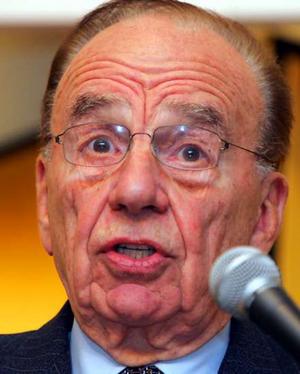
Rupert Murdoch


Keith Rupert Murdoch, AC, KCSG (born Melbourne, March 11, 1931), usually known as Rupert Murdoch, is an Australian-American global media mogul. He is the major shareholder, chairman and managing director of News Corporation (News Corp). Beginning with one newspaper in Adelaide, Murdoch acquired and started other publications in his native Australia before expanding News Corp into the UK, US and Asian media markets. It was in the UK that he diversified into TV, creating Sky Television in 1989. In recent years he has become a leading investor in satellite television, the film industry, the Internet and the media.

According to the 2008 Forbes 400, Murdoch is the 109th-richest person in the world, with a net worth of $8.3 billion.

Acquisitions in Britain

Murdoch expanded into Britain in 1968. He succeeded in beating rival publisher Robert Maxwell to the acquisition of The News of the World, which had once been the most popular English-language newspaper in the world, with a claimed peak circulation of 8,441,966 in 1950. By 1968, circulation had dropped to around six million, and a substantial number of its shares were offered for sale by a member of the Carr family, which had part-owned and managed the company for nearly seventy years.

It was also the first time that Murdoch risked the entire business he had already created on the outcome of a new venture, as he mortgaged the most valuable of his existing Australian properties in order to buy the paper, having been promised that he would share control with the existing Carr management. After succeeding in this, Murdoch not only controlled The News of the World but had completely regained full ownership of all his Australian assets.

When the daily newspaper The Sun entered the market in 1969, Murdoch acquired it and turned it into a tabloid format; by 2006 it was selling three million copies per day.

Murdoch acquired the London Times (and The Sunday Times), the paper Lord Northcliffe had once owned, in 1981. The distinction of owning The Times came to him through his careful cultivation of its owner, who had grown tired of losing money on it.

During the 1980s and early 1990s, Murdoch's publications were generally supportive of the UK's Prime Minister Margaret Thatcher.

At the end of the Thatcher/Major era, Murdoch switched his support to the Labour Party and the party's leader Tony Blair. The closeness of his relationship with Blair and their secret meetings to discuss national policies was to become a political issue in Britain.

In 1986, Murdoch introduced electronic production processes to his newspapers in Australia, Britain and the United States. The greater degree of automation led to significant reductions in the number of employees involved in the printing process. In England, the move roused the anger of the print unions, resulting in a long and often violent dispute that played out in Wapping, one of London's docklands areas, where Murdoch had installed the very latest electronic newspaper publishing facility in an old warehouse. The unions had been led to assume that Murdoch intended to launch a new London evening newspaper from those premises, but he had kept secret his intention to relocate all the News titles there.[citation needed] The bitter dispute at Fortress Wapping started with the dismissal of 6000 employees who had gone on strike and resulted in street battles, demonstrations and a great deal of bad publicity for Murdoch. Many suspected that the Conservative government of Margaret Thatcher had colluded in the Wapping affair as a way of damaging the British trade union movement. Once the Wapping battle had ended, union opposition in Australia followed suit.

Today, most print newspapers around the world are published using his automated production methods, with significant cost savings as a result.

News Corporation has subsidiaries in the Bahamas, the Cayman Islands, the Channel Islands and the Virgin Islands. From 1986, News Corporation's annual tax bill averaged around seven per cent of its profits.

Sir Michael Grade CBE


Early life

Grade was born into a Jewish show business family originally called Winogradski; his father was the theatrical agent Leslie Grade, while his uncles were the impresarios Lew Grade and Bernard Delfont. He was educated at Stowe School, and St Dunstan's College, London.

Career

He began his career with the Daily Mirror in 1960, and was a sports columnist from 1964 to 1966. By an account he told himself (on a Channel 4 chat-show, entitled The Late Clive James), the job had been organised by his father. When his father suffered a serious stroke in 1966, the 23-year-old Grade moved into his theatrical business. In 1969 he moved to London Management & Representation.

London Weekend Television

He went into television in 1973 when he joined London Weekend Television (LWT) as Deputy Controller of Programmes (Entertainment), achieving the post of Director of Programmes in 1976. At LWT, Grade worked alongside both John Birt and Greg Dyke and as Director of Programmes commissioned the controversial series Mind Your Language as well as the popular The Professionals and the long running arts strand The South Bank Show. In 1981 he had a stint in the United States as President of independent production company Embassy Television and as an independent producer.

BBC (1st stint)

Grade joined BBC Television in 1984 as Controller of BBC1, becoming Director of Programmes in 1986 and Managing Director Designate in 1987. His tenure as Controller was especially controversial, with several high profile public outcries over decisions, such as the decision to stop importing Dynasty (subsequently reversed) and the forced 18-month hiatus for Doctor Who in 1985. It is not entirely clear the extent to which Grade alone was responsible for these rulings, but in the case of both Dynasty and Doctor Who, he became the most prominent target of the campaigns to save the series. In recent years, Grade has, on a number of occasions, claimed that he postponed Doctor Who out of personal dislike. Later in 1986 he took the decision to fire actor Colin Baker from the title role of Doctor Who. Grade was going out with Baker's ex-wife, Liza Goddard, at the time. In 2003, Grade remarked to a journalist for The Daily Telegraph that he had fired Baker because he thought his portrayal of the Doctor was "utterly unlikable, absolutely god-awful in fact."

Grade was also responsible for the repeating of Australian soap opera Neighbours, at first purely an afternoon programme, in a later timeslot, on the advice of his daughter who was irritated that she could not watch it due to her being at school. This proved to be a successful scheduling decision that still remained in place until February 2008 before it moved to Five, and paid off at the time with audiences in excess of 15 million viewers for the new 5.35pm showings. It acted as a target finish time for CBBC and as a buffer between it and the 6 O'Clock News. He also came close to completely axing the sitcom Blackadder, judging the first series to be unfunny, because of lukewarm reviews and high cost (it featured extensive location sequences). He demanded that the price for renewing the series was that it be a completely studio-based production with an audience. It went on to become one of the most successful British sitcoms of all time.

Channel 4

In 1987 he returned to commercial television, accepting the post of chief executive of Channel 4, replacing Jeremy Isaacs. Grade phased out some of the channel's more high-brow programming, for which he was accused of 'dumbing down'. Grade responded that in the week he took over at Channel 4 they had screened a repeat of The Far Pavilions in which the American actress Amy Irving blacked up as an Indian Princess. During this period he was attacked by the Conservative press: the columnist Paul Johnson in the Daily Mail gave him the soubriquet of Britain's "pornographer-in-chief". He was successful in developing the business at a time when Channel 4 was obliged to give a proportion of its advertising revenue to the rival ITV network. As well as securing talent from the BBC Grade also recognised the improving quality of US television output making series such as Friends and ER mainstays of the channel's schedule. Grade also became embroiled in a vicious dispute with Chris Morris over the series Brass Eye. He went from Channel 4 to head First Leisure Corporation, leaving there in 1999 after a substantial restructuring to return to media as chairman of the new Pinewood Studios company.

BBC (2nd stint)

Grade had ambitions to become chairman of the BBC board of governors in 2001, but lost out to Gavyn Davies. He was also on the board of the ill-fated Millennium Dome. He has been chairman of Octopus Publishing, the Camelot Group, and Hemscott, which he has indicated he will be giving up.

Following Davies' resignation as a result of the Hutton Inquiry report, it was announced on 2 April 2004 that Grade had been appointed Chairman of the Board of Governors of the BBC; at the time his only show-stopper requirement was that he did not have to give up being a Charlton Athletic Director. He took up his post on 17 May.

Following the end of the first season of the revived series of Doctor Who in 2005, he wrote a letter to the BBC Director-General, congratulating all involved in the project on its success, signing-off with "PS never dreamed I would ever write this. Must be going soft!"

On 19 September 2006, he joined Ocado (the Waitrose food delivery company) as Chairman.

ITV plc

On 28 November 2006, Grade and the BBC confirmed that he was to resign from his post with the BBC to replace Sir Peter Burt as Chairman and Charles Allen as Chief Executive of one of the companies which formed part of its commercial rival ITV, becoming Executive Chairman of ITV plc effective on 8 January 2007.

ITV as a network, has been struggling with falling advertising and ratings. Mr Grade said his first priority within ITV plc would be to work as a senior partner of ITV Network Limited to improve ITV programming as well as improving its own Digital Channels ITV2,ITV3,ITV4 and CITV. On 12 September 2007, Grade announced a controversial five-year restructuring plan for ITV plc owned Regions targeting entertainment as the Broadcasters top priority to bring to ITV . A major overhaul of ITV Plc's regional structure was also proposed. The proposals would see consolidation of the ITV regional news programmes in England, with regions now broadcasting one service per region rather than multiple tailored local services (for example: ITV Yorkshire would no longer broadcast separate Northern and Southern regions). The proposed changes would also fully merge ITV Border with ITV Tyne Tees and ITV West with ITV Westcountry, effectively ending two regions' tenure as independent players within ITV, these proposals have been highly criticized by BECTU and The National Union of Journalists. Any changes would be subject to full approval by Ofcom.

Private life

He was made a CBE in 1998, and is married to his third wife, Francesca; they have a son, Samuel. He was previously married to Penelope Jane Levinson, with whom he had two children, and Sarah Lawson, a producer.

Source: Wikipedia

Sir Jeremy Isaacs


Early life

He was born in Glasgow, the son of a jeweller and a GP and grew up in Hillhead. He was educated at the independent Glasgow Academy and Merton College, Oxford. He did his National Service in the Highland Light Infantry.

Television career

Isaacs began a long career in television in 1958 by joining Granada Television as a producer. At Granada he was involved in creating acclaimed and long running series World in Action and What the Papers Say. He has worked for the BBC (on Panorama)) in the 1960s and was the overall producer for the acclaimed 26-episode series The World at War for Thames Television in 1973. He was Director of Programmes for Thames between 1974 and 1978. He then produced Ireland: A Television History (1981) for the BBC.

Channel 4

Isaacs was the founding chief executive of Channel 4 between 1981 and 1987, overseeing its crucial launch period and setting the channel's distinctive style. At that time, the channel was much more serious in tone and dedicated to minority cultural tastes than it is now, though such programmes as The Tube had a place on the network from the start. The channel commissioned Michael Elliott's production of King Lear with Laurence Olivier in the title role and Isaacs re-commissioned a number of programmes from his time at Granada including What the Papers Say. Despite a general liberal atmosphere, a few commissioned programmes such as Ken Loach's A Question of Leadership were blocked from being screened.

When handing over responsibility for running the channel to Michael Grade, Isaacs threatened to throttle him if he betrayed the trust placed in him to respect the channel's remit.

Royal Opera House

After leaving Channel 4, and failing to be appointed Director General of the BBC in 1987, Isaacs became General Director of the Royal Opera House, Covent Garden, a role he fulfilled until 1996. This was a difficult period for the ROH, which was not helped by the broadcast of the revealing The House (1996) documentary series on BBC2.

Ted Turner sought out Isaacs (confusing him with the actor Jeremy Irons) for the role of executive producer for his 1998 24-episode Cold War series.

Between 1997 and 2000 Isaacs was president of the Royal Television Society. He is currently chairman of Sky Arts.

From 1990 to 1998 Isaacs acted as interviewer in a revival of the BBC series Face to Face; John Freeman had filled this role in the original 1959-62 run.


Source: Wikipedia

David Elstein


David Elstein is chairman of Sparrowhawk Media, which owns the UK and international versions of the Hallmark Channel. He is also chairman of the British Screen Advisory Council, Luther Pendragon Ltd, Screen Digest Ltd, DCD Media plc and Sports Network Group plc, and is a non-executive director of NTL Inc. David Elstein was Chief Executive of Channel Five from 1996 to 2000, and was previously Head of Programming at BSkyB and Director of Programmes at Thames Television.

Source: British Screen Advisory Council

Alan Yentob


Alan Yentob is the Creative Director for the BBC.

His role is to ensure that the Creative Future recommendations are implemented across all content and services.

He has responsibility for a significant film division and chairs the board of BBC Films.

He is also the focal point for talent management across the whole of the BBC.

Alan is the Chair of the Creative Training Board, the Creative Network and the new Arts Network which will pull together arts programme-makers from across the BBC.

In Spring 2003 Alan presented and wrote the landmark documentary on Leonardo Da Vinci and became host of BBC One's successful and acclaimed arts strand, Imagine.

A celebrated and award-winning programme maker, Alan quickly came to personify the creative spirit of the BBC.

He joined as a general trainee in 1968, taking his first job in the World Service.

From 1973 to 1975 he was a producer/director with Omnibus, where his films famously included Cracked Actor with David Bowie.

In 1978 he created the mould-breaking arts series Arena, and was Editor until 1985. During this time Arena produced influential programmes including The Private Life Of The Ford Cortina and My Way.

In 1985 he became Head of Music and Arts and stayed in the post until 1988 when he was appointed Controller of BBC Two.

Under Alan's five year stewardship BBC Two was re-vitalised and introduced many innovations in programming including The Late Show, Have I Got News For You, Absolutely Fabulous and Wallace and Gromit's The Wrong Trousers.

Factual programme successes included Troubleshooter and Video Diaries.

He was appointed Controller of BBC One in 1993, significantly improving its content and share.

He became Director of Programmes in Production in 1997, then Director of Television between 1998 and April 2000 when he became Director of Drama, Entertainment and CBBC.

In June 2004 he became the BBC's Creative Director.

Alan was born on 11 March 1947.

His outside responsibilities include sitting on the Boards of The South Bank and the International Academy of Television Arts and Sciences, and Chairmanship of the Institute of Contemporary Art and the charity Kids Company.

Source: BBC Press Office


- Return To Main Menu -

My Zimbio
Top Stories
Hit CountersBlog Hit Counter